
At designRoom, AI Is Our Darkroom, Not Our Camera: Why Human-Led AI Strategy Prevails
By Shaun Culbertson | February 4, 2026
There’s a lot of noise right now about how companies “use AI.” Most of it centers on speed, automation, or replacement.
We use it for those things too. But that’s not the whole picture at designRoom.
We don’t use AI to create ideas. We don’t use it to think for us. We don’t hand it a blank page and ask it to make something meaningful.
The thinking is the important part. And that part is still very human.
The Idea Comes First
I’ve been thinking about this through a metaphor that goes back to when I used to shoot film photography.
Before the darkroom, there was the work. You had to see the image first. You chose the subject. You framed the shot. You composed it. You decided on the moment, the light, the angle. All on top of having a purpose for the shot in the first place.
That was the thinking.
By the time you pressed the shutter, the photograph already existed in your head. The camera didn’t invent it. It captured a decision you had already made.
That’s how we treat ideas at designRoom.
The purpose.
The strategy.
The concept.
The point of view.
All of that happens before AI ever enters the picture.
AI Is the Darkroom
If the idea is the photograph, AI is the darkroom.
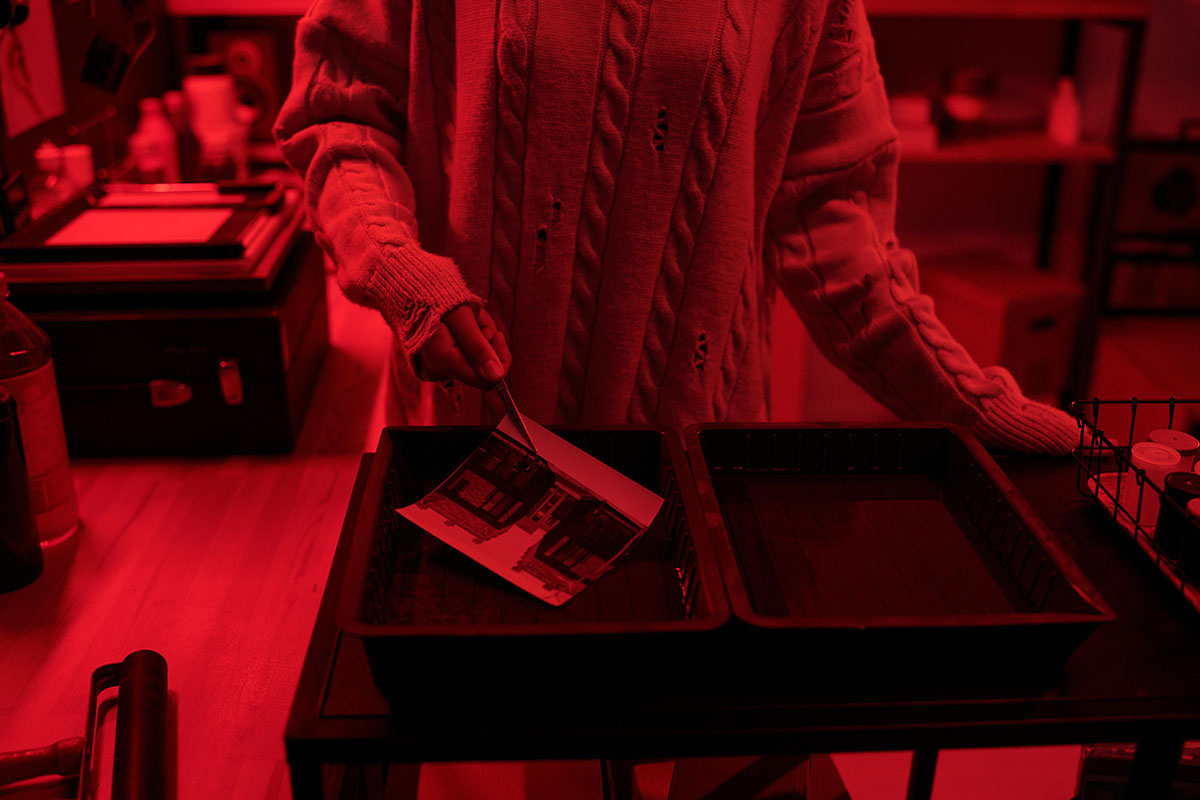
Back then, the darkroom felt like magic. You’d take a blank sheet of paper and slide it into the chemical tray. Slowly, mysteriously, the image would begin to appear. First a hint, then a shape, then the full photograph reveals itself right in front of you.
But the chemicals weren’t deciding what the image was. They weren’t composing it.
They weren’t choosing the subject. They were revealing what I had already seen, thought about and created. The chemicals were the magic that brought the image to life.
That’s exactly how we use AI in the creative process.
We bring clear ideas into it. Ideas that already have a point of view and are on strategy. They may still be rough or incomplete, but the core concept is already there.
We use human-led AI strategy to support that work: to fast-track research, to refine language, to explore alternatives, and to stress-test decisions we’ve already made. It helps us move more quickly through the surrounding work, not replace the thinking that defines the idea.
Of course, thinking and making aren’t perfectly separate. Anyone who’s done creative work knows that ideas evolve through execution. You learn by seeing something take shape, by reacting to what appears, by refining and adjusting along the way.
But there’s a difference between discovering an idea through the process and delegating the thinking altogether. AI can accelerate iteration and expand the space of possibilities, but it still needs a point of view to react against. Without intention, direction, and judgment, all you get is more output — not better ideas.
AI helps the creative process to:
- Expand an idea without diluting it
- See angles we may want to sharpen or discard
- Turn fragments into something cohesive
- Move faster through the “development” phase without skipping the thinking
It’s chemistry, not authorship.
The Danger Is Skipping the Thinking
The real risk with AI isn’t that it’s powerful. It’s that it makes it tempting to skip the hard part.
If you go straight to the darkroom without knowing what you’re trying to say, you’ll still get an image, but it likely won’t mean anything or stand out.
We’re not interested in volume for its own sake. We’re interested in clarity and ideas that hold up because they were thought through before they were developed.
Where We Draw the Line
Just as important as how we use AI is where we choose not to use it.
We don’t use AI to do the actual design work. We don’t use it to develop core concepts. And we don’t use it to generate imagery that ends up in the final creative.
At designRoom, we talk a lot about helping our clients “stand out.” That means telling a story that’s distinctly theirs, that positions and differentiates them in the market. We don’t believe you can truly stand out if you’re relying on AI for creative execution. By its nature, AI optimizes toward what already exists.
Standing out requires originality. It requires decisions that feel a little uncomfortable because they haven’t been proven yet. That kind of work comes from people, not probability.
AI can help sharpen an idea. But the final choices, like the look, the feel, the expression is where authorship lives.
If everyone uses the same tools in the same way, the work starts to converge. And convergence is the opposite of standing out.
That’s the Work
So, when people ask how we use AI at designRoom, this is the answer:
We use it after the thinking. We use it to reveal, not invent. We use it like a darkroom — not a camera.
The magic isn’t in the chemicals.
The magic is in knowing what picture you’re trying to make before you ever turn the lights off.

About the Author
Chad Gordon is the Creative Director at designRoom, where he leads original brand development and marketing initiatives for national behavioral healthcare organizations. Since 1991, he has specialized in identity development and photo illustration, earning numerous national honors, including multiple ADDY Awards for excellence in design. Chad holds a degree in photo illustration from Ohio University and studied photography in Edinburgh, Scotland. His design work has been featured in international design publications, and his photography has been exhibited in galleries throughout Northeast Ohio.
About dR
At designRoom, we make it our business to find real answers and create custom healthcare brands. We believe effective healthcare branding is grounded in research, directed by insight, and driven by strategy.
We love seeing how strategic branding helps the right clients find the right organizations and receive the right care. That’s been our focus for over a decade. Today designRoom is an award-winning, national branding and design firm, known for helping clients build and promote healthy, sustainable brands. And we are super proud of that.